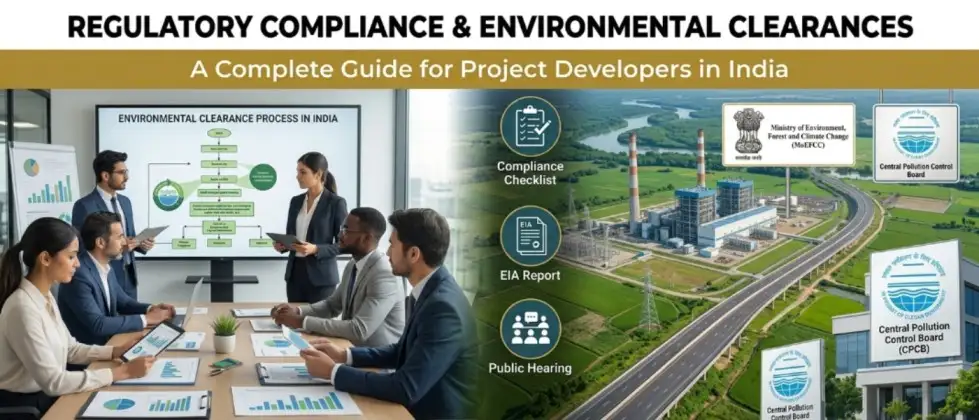
In today’s highly regulated business environment, regulatory compliance and environmental clearances are not just legal formalities — they are critical milestones that determine whether your project moves forward smoothly or faces costly delays.For industries, infrastructure developers, real estate promoters, and manufacturing units, obtaining the right environmental approvals at the right time is essential for operational success.
For industries, infrastructure developers, and manufacturing units, obtaining the right environmental approvals at the right time is essential for operational success.
Why Regulatory Compliance is Crucial for Your Project
Environmental laws in India are designed to ensure sustainable development while protecting natural resources, air quality, water bodies, and surrounding communities.Failure to obtain required environmental clearances can result in:
- Project delays or shutdowns
- Heavy penalties and legal notices
- Rejection of funding or investor withdrawal
- Damage to brand reputation
- Increased scrutiny from regulatory authorities
Proper environmental compliance management ensures your project operates within legal boundaries and builds long-term sustainability.
What Are Environmental Clearances?
Environmental Clearances (EC) are statutory approvals required from government authorities before starting certain types of projects such as:
- Industrial units
- Infrastructure projects
- Mining activities
- Real estate developments
- Large-scale manufacturing facilities
These approvals confirm that your project complies with environmental regulations and does not cause unacceptable environmental impact.
Key Environmental Approvals Required in India
Depending on the project type, scale, and location, businesses may require:
1. Environmental Clearance (EC)
Mandatory for projects listed under the EIA Notification.
2. Consent to Establish (CTE) & Consent to Operate (CTO)
Issued by State Pollution Control Boards before construction and operation.
3. Hazardous Waste Authorization
Required for industries generating hazardous waste.
4. Water & Air Act Permissions
Compliance under the Water (Prevention and Control of Pollution) Act and Air Act.
5. Forest & Coastal Regulation Zone (CRZ) Clearance (if applicable)
Required for projects near forest land or coastal areas.Understanding which approvals apply to your project requires technical and regulatory expertise.
Common Challenges in Environmental Regulatory Compliance
Many project developers face difficulties such as:
- Incomplete documentation
- Delays in approval timelines
- Changing environmental regulations
- Changing environmental regulations
- Non-compliance notices from authorities
Without expert guidance, these issues can significantly impact project cost and schedule.
How Korde Environment Engineering LLP Supports Your Compliance Journey
At Korde Environment Engineering LLP, we provide end-to-end support for:
- Environmental regulatory assessment
- Preparation of compliance documentation
- Liaison with regulatory authorities
- Application submission and follow-ups
- Risk identification and mitigation
- Post-clearance compliance monitoring
Our approach ensures that your project meets all environmental legal requirements while maintaining efficiency and transparency.
Benefits of Professional Environmental Compliance Management
Partnering with experienced environmental consultants offers:
- Faster approval timelines
- Reduced legal and financial risk
- Improved project credibility
- Stronger investor confidence
- Sustainable and responsible project execution
Environmental compliance is not just about avoiding penalties — it is about building responsible and future-ready projects.
Common Challenges
Documentation Gaps
Incomplete or technically inaccurate documentation often leads to immediate rejection or long delays.
Misinterpretation
Misinterpreting complex regulatory requirements can result in non-compliance notices from authorities.
Changing Regulations
Frequent amendments in environmental law require constant expert monitoring to stay compliant.
Why It Is Crucial
Failure to obtain required environmental clearances can result in heavy penalties, legal shutdowns, or investor withdrawal.
Benefits of Professional Management:
- Accelerated project approval timelines
- Elimination of hidden environmental liabilities
- Improved credibility for project financing
- Sustainable and future-ready industrial execution